
A Complete Guide to Different Types of Fasteners
Fasteners are critical hardware parts used to join or hold two or more objects together. Generally, they are categorized into permanent fasteners, like rivets, and non-permanent fasteners, like screws. You can’t remove the permanent fasteners without breaking or damaging the parts. However, different types of fasteners are available for temporary joining, and you can easily remove them whenever you need to fix or adjust something.
Fasteners are important components that keep everything around us together. These small components play a key role in holding buildings, cars, and large equipment together. From construction to industrial machinery and automobiles, these are used in almost every industry. Understanding the different types of fasteners is a must for businesses and professionals so that they can choose the right one for their applications. Keep reading to know about the major types of fasteners, their uses, and how to choose the right one for your project.
Table of Contents
Why Do High-Quality Fasteners Matter?
Fasteners are small but essential hardware tools like screws, bolts, and washers. Their main job is to hold two or more things together securely. Many of them temporarily connect things so you can remove them without breaking them. Whether you are working in the manufacturing or construction industry, using top-grade fasteners is a must.
- Good quality fasteners can easily handle heavy weights and intense vibrations without bending or breaking.
- By using high-grade fasteners, you can prevent costly repairs and dangerous collapses.
- Top-quality fasteners are coated and made with special materials that easily resist rain, heat, and humidity.
- Premium fasteners are costly, but you don’t need to constantly replace or tighten them. So, you can save money on maintenance by choosing them.
- Trusted fastener suppliers like National Oil Groups offer products that exactly fit your needs. Choosing fasteners with incredible strength means ensuring the safety of your project for years.
Common Categories of Fasteners: Key Types
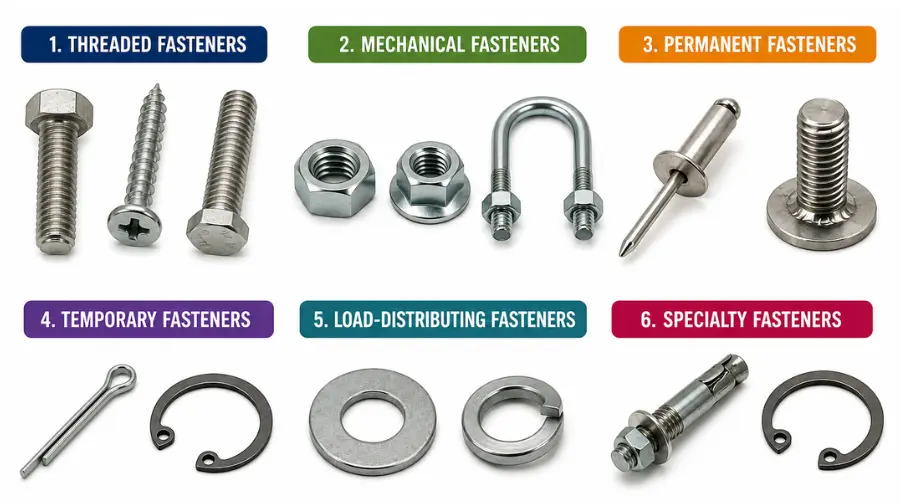
Fasteners are used in almost every industry in KSA and across the world to securely join or hold two or more objects together. You can consider them as the glue that holds everything from your smartphones to towering skyscrapers. Here are the 6 main types of fastener:
| Fastener Type | Common Examples | Main Use |
| Threaded Fasteners | Bolts, Screws | Joining parts that may need assembly and disassembly |
| Mechanical Fasteners | Hex Nuts, U-Bolts | Securing components with a strong clamping force |
| Permanent Fasteners | Rivets, Welded Studs | Creating permanent and highly secure joints |
| Temporary Fasteners | Cotter Pins, Retaining Rings | Holding parts that require regular maintenance |
| Load-Distributing Fasteners | Flat Washers, Spring Washers | Spreading pressure and preventing loosening |
| Specialty Fasteners | Anchors, Retaining Rings | Solving specific fastening and installation needs |
1. Threaded Fasteners
These feature spiral grooves or helical ridges that are called threads. These threads help the fastener to grip tightly onto materials or lock into a matching hole or nut. The best part is that they can create a strong hold and are very easy to install. You don’t need special tools to install them, as they can be installed using screwdrivers and wrenches. These are used in parts that need to be assembled and disassembled, like car engines and household furniture.
Examples
- Bolts: These pass through un-drilled or pre-drilled holes and are secured using a nut. Common types are six-sided Hex bolts used for heavy construction and carriage bolts used for woodworking.
- Screws: Unlike bolts, they feature tapered shafts and sharper threads. These are designed to cut either directly into a material or to fit into holes that are already threaded. Common types are wood screws, deck screws, and sheet metal screws.
2. Mechanical Fasteners
Mechanical fasteners join materials and hold parts in a fixed position using physical clamping force and geometric shapes. They are very strong and are designed to resist heavy vibrations. They make sure the joints stay rigid and don’t shift under stress or daily use. They don’t cut deep threads into a material and lock together as a system. Different types of fasteners of this type use components that sandwich materials together to distribute weight and pressure evenly.
Examples
- Hex Nuts: They screw onto bolts to join materials together, and flange nuts with a wide circular base that spread out clamping pressure.
- U-bolts: These feature threads on both ends and are perfect for wrapping around and securing pipes and tubes.
3. Permanent Fasteners
As their name suggests, these fasteners join materials together for a lifetime. Once installed, they can’t be removed without destroying the fastener or the materials holding them together. They are very tough and are used when maximum security and zero loosening are required. They are very reliable and are used in airplanes, bridges, and other big metal frames.
Examples
- Rivets: Once they are inserted into a pre-drilled hole, their tail end is flattened to lock them in place. They are commonly used in metalworking and manufacturing, and metalworking.
- Welded Studs: These are fused directly to a metal surface using heat and become a permanent part of the material.
4. Temporary Fasteners
Unlike permanent fasteners, these are made for parts that need to be assembled and disassembled frequently. They hold things securely when needed, and you can easily disassemble them without damaging any component. These are used for access panels, battery covers, and machinery that need regular maintenance.
Examples
- Pins and Cotter Pins: These are used to secure moving parts or prevent nuts from backing off.
- Retaining Rings (Circlips): These metal rings are snapped into grooves to hold components like bearings or gears, and can be easily removed with special pliers.
5. Load-Distributing Fasteners
Different types of fasteners of this category are used to protect your project from damage by spreading out the heavy clamping forces evenly. They work as a support element and are often placed between a main fastener and the surface of a material. They also stop parts from crushing and rubbing against each other during assembly.
Examples
- Flat Washers: These simple and flat metal disks are used to distribute the load of the threaded fastener uniformly, preventing damage to the surface.
- Spring Washers: These are curved or split washers that prevent the nut or bolt from loosening due to vibration.
6. Specialty Fasteners
These are unique hardware pieces that are designed for specific tasks or uncommon mechanical problems. Different types of fasteners in this category feature expanding designs and non-traditional shapes. They are used in heavy-duty masonry work and detailed machinery design.
Examples
- Anchors: These are special heavy-duty fasteners used to secure materials safely to solid concrete, masonry, or hollow drywall.
- Retaining Rings: These semi-flexible metal rings snap into pre-machined grooves on a shaft or to stop parts from sliding out of place and keep them aligned along an axis.
How to Choose the Right Fastener for Your Project
Different types of fasteners are available and are used for various applications. Choosing the right one is a must to ensure the joint remains secure for the required time. When selecting the perfect fit for your project, you should consider the following:
- Match the Material: Make sure you match the fastener’s material to the material of your project. Fasteners are made of various materials like carbon steel and alloy steel, and you must choose the material based on the environment. For critical oil and gas applications, businesses often prefer API 20E Fasteners Saudi Arabia suppliers to ensure compliance with industry standards and reliable performance in demanding conditions.
- Consider the Environment: If you are working on an outdoor project, it is best to choose fasteners made from corrosion-resistant materials like stainless steel or hot-dipped galvanized steel. However, zinc-plated screws and nails are perfect for indoor projects.
- Determine the Load: Heavier projects need thicker and stronger fasteners, while standard nails and smaller screws can be used for lighter projects. So, you must choose a fastener that matches your load requirements.
- Choose the Right Head and Thread Type: Flat head fasteners sit perfectly flat with the surface for a smooth finish, while hex head sticks out above the surface to provide a stronger grip. Coarse threads are best for soft woods and drywall, while fine threads are best for hard woods and metals.
Find the Right Fastening Solution for Your Project
Finding the right thread is a must for your safe and lasting structure. Whether you are working on a small repair or a large building project, using the correct screws, bolts, and nuts is a must. Before choosing one for your project, you need to consider the material, load requirements, environment, and other factors.
Connect with National Oil Groups, a top supplier of high-grade fasteners in Saudi Arabia. We offer a variety of quality products and provide fast delivery at the best prices. We understand how poor-quality fasteners can affect your work, so our team also helps you select the right ones based on your needs. Contact us to find the perfect quality parts that keep your projects safe together.
Also Read – Working Principle of an AODD Pump: Complete Guide