
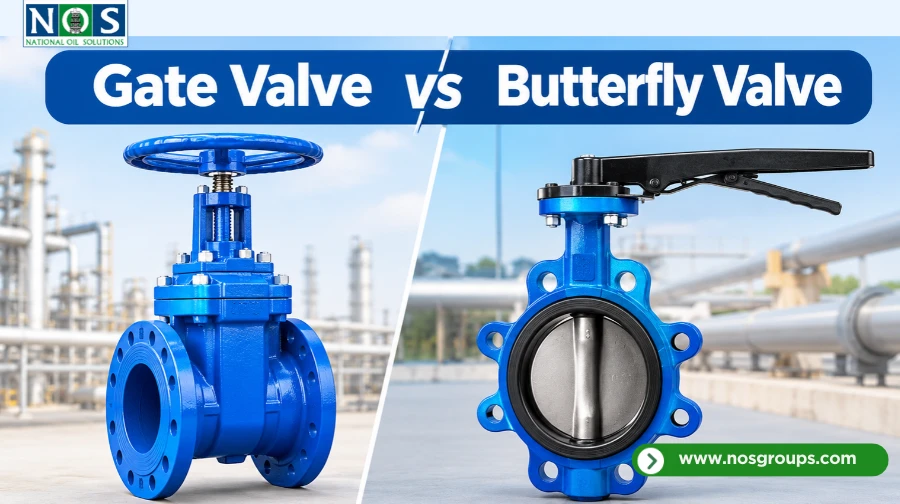
Gate Valve vs Butterfly Valve: Key Differences Explained
When comparing gate valve vs butterfly valve, you will see they work differently to control liquid or gas flow in a pipe. Gate valves are great for turning flow completely on or off, while butterfly valves are better for adjusting how fast the liquid moves.
When you need to control the flow of liquids or gases in a piping system, choosing the right valve is most important. Gate and butterfly valves are the most common valve solutions that are used for different industrial tasks. When you compare gate valve vs butterfly valve, you will understand that they work differently.
One is built for tight seals and high pressure, while the other is preferred for quick operation and saving space. Choosing the right option can lead to serious issues like leaks and system damage. Learning the main differences of butterfly valve vs gate valve is necessary to make the right choice.
Table of Contents
What Are Gate Valves?
Before we compare butterfly valve vs gate valve, let us understand how both work. A gate valve is a control valve used to control the flow of liquids or gases in a pipeline. Its body has a seat and disc that work together to stop the flow when the valve is closed.
This valve works like a sliding gate, as when you turn the handle connected to the spindle, a solid barrier moves straight up or down inside the pipe. This valve is designed to be either fully open or fully closed, so you can’t use it to control the speed or amount of the flow.
How Gate Valves Work
Turning the handwheel moves a threaded rod. It raises or lowers the gate to control flow. When the valve is fully open, liquids move easily. When closed, the gate seals the pipe and stops the flow. You have to turn the handle multiple times to open or close the gate.
6 Main Types of Gate Valves
- Rising Stem Gate Valve: The stem moves up and down outside the valve. You can easily see if the valve is open or closed by looking at it.
- Non-Rising Stem Gate Valve: The stem remains at a fixed height and turns inside the valve. This makes it perfect for underground or space-constrained pipelines.
- Bellow Seal Gate Valve: This valve uses a flexible, metal bellows that is hermetically welded to both the valve stem and the bonnet to prevent leakage of toxic, hazardous fluids.
- Pressure Seal Gate Valve: These are built for heavy-duty power plants. They use internal line pressure to compress and tighten the seal against leaks.
- Cryogenic Gate Valve: This gate valve has an extended bonnet to keep stem packing warm and functional in extremely cold liquids like LNG and liquid nitrogen.
- Forged Gate Valve: These are built from high-strength forged steel to provide superior durability and are used to handle very high pressure and intense heat.



What Are Butterfly Valves?
Butterfly valves are used to control or regulate the movement of liquids or gases inside a pipe. These valves are compact and lightweight compared to other bulky valves. They work by turning a round disc a quarter turn using a central rod connected to a motor or handle.
Because of their special design, trusted butterfly valves Saudi Arabia suppliers, like National Oil Groups, suggest them for tight spaces and underground industrial pipes. A major difference between gate and butterfly valves is that the disc stays in the flow at all times. So, pressure changes within the valve can happen, even when it is partially open.
How Butterfly Valves Work
When the valve is closed, the disc turns perpendicular to the pipe to stop the flow. A quarter turn of the handle rotates the disc parallel to the flow, allowing the liquid to pass through. This makes it incredibly fast and easy to operate.
6 Main Types of Butterfly Valves
- Wafer Butterfly Valve: Thin and lightweight valve sandwiched between two pipe flanges and held in place using long bolts spanning across the body.
- Flanged Butterfly Valve: This valve has integral flanged ends that bolt directly to pipe ends, making it very strong for large and high-pressure systems.
- Zero Offset Butterfly Valve: This valve features a turning rod that goes right through the disc’s center. The disc rubs against a soft rubber seat every time it closes.
- Double Offset Butterfly Valve: This valve uses two distinct stem displacements to reduce seat friction, ensuring tighter seals and longer service life.
- Triple Offset Butterfly Valve: This type of butterfly valve uses three distinct offsets to provide bubble-tight sealing, zero friction, and high-pressure wear resistance.
- Lug Butterfly Valve: This valve has threaded inserts around the body. Bolts screw into them from both sides, supporting dead-end service and single-side pipe disconnection.
Gate Valve vs Butterfly Valve: Key Differences
After comparing the working and types of butterfly valve vs gate valve, you now know that both types differ in operation speed, pressure handling, and installation space.
| Factor | Gate Valve | Butterfly Valve |
| Cost | Usually costs more, especially in larger sizes. | Generally costs less, particularly in larger sizes. |
| Installation Space | Needs more space for installation. | Requires less installation space. |
| Weight | Heavier and may need extra support. | Lighter and usually needs less support. |
| Maintenance | Can be harder to handle due to its size and weight. Suitable for pigging and swabbing. | Easier to install and maintain, but not suitable for pigging and swabbing. |
| Operation Speed | Opens and closes more slowly. | Opens and closes quickly, but may increase water hammer risk. |
| Flow Regulation | Mainly used for fully open or fully closed flow. | Can regulate or throttle flow. |
| Flow Resistance | Creates less resistance when fully open. | The disc creates more flow resistance. |
| Pressure Handling | Suitable for higher-pressure applications. | Generally used for lower-pressure applications. |
| Sealing | Provides tight shut-off for applications requiring minimal leakage. | Sealing performance depends on the valve design and application. |
| Applications | Best for systems needing full flow and minimal obstruction. | Best for systems needing compact installation or flow regulation. |
| Slurry Flow | Useful when slurry flow does not require regulation. | Useful when slurry flow needs regulation. |
Choosing the Right Valve Supplier in Saudi Arabia
When comparing trusted suppliers for gate and butterfly valves Saudi Arabia, you must focus on the following factors:
- Product Quality: Check the quality and durability of the valves.
- Industry Standards: Ensure products meet the required standards.
- Pressure Ratings: Choose valves suitable for your system’s pressure.
- Material Selection: Confirm materials match your operating conditions.
- Product Availability: Look for suppliers with the required valve types and sizes.
- Delivery Support: Check delivery timelines across Saudi Arabia.
Get the Right Valve Solution for Your Saudi Project
After comparing gate valve vs butterfly valve, it is clear now that both play important roles in pipeline management. Gate valves block flow completely without pressure drops, while butterfly valves are perfect for regulating flow and save valuable space.
Connect with National Oil Groups to get top-quality valve solutions for the toughest industry conditions. We are a trusted name among the best gate and butterfly valves Saudi Arabia suppliers and offer a wide range of high-quality valves.
Need the perfect gate valves saudi arabia and butterfly valve Saudi Arabia solutions for your project? Speak to our experts today, share your specifications, and get a custom quote for your project.
Also Read – Top 10 Oilfield Equipment Suppliers in Saudi Arabia