
How Does a Butterfly Valve Work? Working Principle, Types, and Industrial Applications
A butterfly valve works by rotating a disc inside a pipe to control, regulate, or stop the flow of liquids and gases. Its quarter-turn operating mechanism allows quick flow control, making it a widely used solution in water treatment, oil and gas, and other industrial applications.
Butterfly valves are typically used in piping systems that require efficient flow management and immediate shutoff. When asking yourself what is a butterfly valve used for, you will realize that its main purpose is to regulate and control the fluid’s flow through various industries. Their lightweight, compact design makes them ideal when large valves aren’t feasible.
In this blog, we will explore how butterfly valves work, their main components, different butterfly valve types, and their applications across various industries. We will also discuss their key benefits and important factors to consider when choosing the right valve for your industrial requirements.
Table of Contents
What Is a Butterfly Valve?
The butterfly valve is a quarter-turn valve that controls, regulates, and isolates the flow of fluids or gases in a pipeline system. The valve contains a circular disc attached to a rotating shaft in the valve body. Turning the shaft by the handle or actuator rotates the disc, which helps in opening, closing, or regulating the flow of fluids through the valve.
Unlike many other valves, the butterfly valve is compact and has fewer components. Therefore, the valve is relatively lightweight and easy to install in pipelines where there is little space available.
Features of a Butterfly Valve
- Compact Size: It requires less installation space than most other valve constructions.
- Rapid Operation: It can open and close with a quarter-turn rotation.
- Flow Control: It controls the volume of the fluid passing through the pipe.
- Easy Maintenance: It has a fairly simple structure with few moving parts.
- Diverse Applications: It can be used in various industrial processes based on the valve material and construction.
How Does a Butterfly Valve Work?
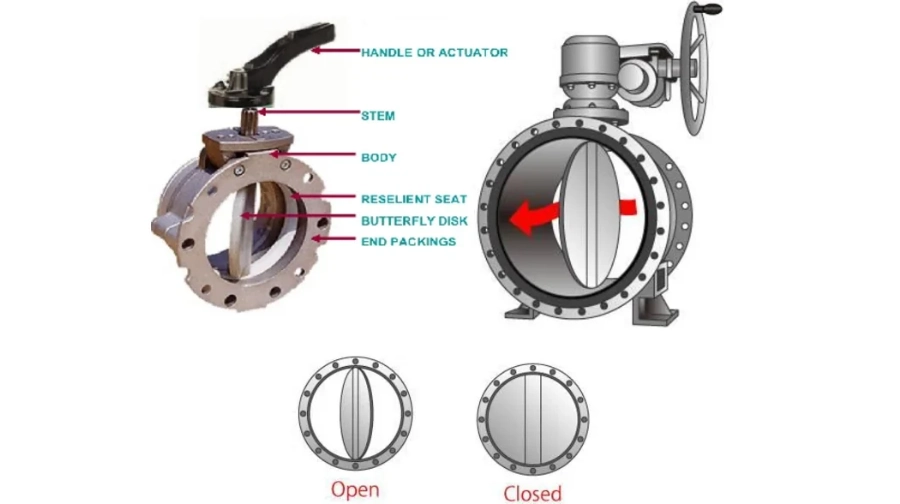
A butterfly valve operates on the basis of a disc that rotates inside the pipeline. If you want to understand how does a butterfly valve work, the process is simple. The disc is joined to a shaft, whereby it moves when the operating parts, like the handle or gearbox, are rotated. Through this movement, it determines the amount of fluid flowing through the pipeline. It uses the quarter-turn principle and moves 90 degrees to be closed or opened.
Butterfly Valve Working Principle
This working principle consists of the following three positions:
1. Open Position: At the point where the handle or the actuator rotates the shaft by 90 degrees, the disc gets aligned parallel to the direction of flow of the fluid. In this way, the fluid flows through the pipeline with little hindrance.
2. Closed Position: As the disc aligns itself in the perpendicular position, the flow passage gets blocked and thus stops the flow of fluid through the pipeline.
3. Throttling Position: The disc can also stay at an intermediate position to control the flow of the fluid.
How Do Butterfly Valves Work in Industrial Systems?
Butterfly valves are controlled either manually or automatically in industrial settings, depending on the process. The former type has either a lever or gearbox as an actuator, while the latter has an electric, hydraulic, or pneumatic actuator as a means of controlling the movement of discs.
Main Components of a Butterfly Valve
Butterfly valves have different parts that interact with one another to regulate the flow of fluids in a pipeline. The different parts play different roles, ranging from providing structural support to regulating the turning motion of the disc and preventing leaks.
The following are the major parts and their functions:
1. Valve Body
The valve body comprises the outer shell of the butterfly valve and is used to attach the valve to the pipeline. It holds the valve parts and is made to withstand the operating pressure and environmental conditions of the system.
2. Disc
The disc refers to the primary flow control part that is located within the valve body. It allows rotation for opening, restricting, or closing the flow path of liquids or gases.
3. Stem or Shaft
The stem is connected to the operating mechanism and allows the transfer of rotational motion to the disc. In this way, the valve changes its position.
4. Seat
The seat serves as a sealing surface between the valve body and the disc. Its main purpose is to prevent any fluid leaks in case the valve is in a closed position. Seat materials differ according to operating conditions.
5. Actuator or Operating Handle
The actuator or operating handle allows control of the movements of the valve. This part might be a manually controlled lever, gearbox, or even an automatic actuator driven by electricity, air, or hydraulic pressure.
6. Seals and Bearings
Seals are used to avoid leakage around the stem and other connections, whereas the bearings provide smooth shaft rotation and friction reduction.



Different Types of Butterfly Valves
There are various types of butterfly valves available in the market, which are used to control the flow rate of liquids or gases in industries according to the required conditions. The differences in various butterfly valve types are with respect to disc design, sealing system, and pressure resistance.
1. Types Based on Disc Design and Shaft Offset
- Concentric (Zero-Offset) Butterfly Valve: Central disc and shaft, with a soft seat. For use in low-pressure, cold water, HVAC, and other applications.
- Double-Offset (Double Eccentric) Butterfly Valve: Possesses two shaft offsets, which result in reduced disc-to-seat contact and reduce wear. Appropriate for moderate-to-high pressure services, with chemical and oil and gas services in the broad process market.
- Triple-Offset (Triple Eccentric) Butterfly Valve: It has three offsets to reduce friction and allow tight sealing by metal-to-metal contact. It finds its applications in various demanding, high-pressure, high-temperature industrial applications.
2. Types Based on Pipe Connection Style
- Wafer Type: Installed between two pipe flanges with a compact, light, and economical construction.
- Lug Type: Fitted with threaded lugs that make bolted joints possible and provide end-of-line isolation where feasible.
- Flanged Type: Equipped with flanges on both sides for mounting, especially in large-diameter pipelines.
- Butt-Welded Type: Joined to the pipeline through welding and used in special applications.
3. Types Based on Seat Material
- Soft-Seated Butterfly Valve: Materials like EPDM, NBR, VITON, and PTFE are used to provide an effective seal. This type of valve is ideal when shut-off tightness is required.
- Metal-Seated Butterfly Valve: Metallic materials like stainless steel, Stellite, and Inconel are used for its construction. It is suitable for high-temperature and high-pressure situations.
4. Types Based on Actuation Method
- Manual Actuation: Operates the disc using a lever handle or gearbox manually.
- Pneumatic Actuation: Operates the valve using compressed air to enable faster and automatic valve operation.
- Electric Actuation: Operates the valve using an electric motor for remote operation and flow control.
- Hydraulic Actuation: Uses hydraulic pressure to produce the torque necessary for heavy-duty applications.
Selection Tip: The suitable butterfly valve is based on factors such as operating pressure, temperature, fluid, pipeline connection, and sealing. Considering these factors will assist industries in selecting the appropriate valve.
Industrial Applications of Butterfly Valves
Butterfly valves are employed to control, manage, and isolate the flow of liquid and gas through industrial pipes. The small size and rapid quarter-turn nature of these valves make them ideal for applications where effective flow control and shut-off are required.
Some of the major applications of butterfly valves include:
- Oil and Gas Industry: Controls the flow of oil, gas, and other fluids through pipelines.
- Water Treatment Plants: Control the flow of water in water treatment, distribution, and wastewater management systems.
- Chemical Industry: Controls the flow of chemicals and process fluids.
- Power Generation Plants: Utilized in cooling water lines, steam lines, and utility lines.
- HVAC Systems: Controls the flow of water and air in heating, ventilation, and air-conditioning systems.
Selection of the correct valve is based on fluid characteristics, pressure, temperature, and system needs.
How to Choose the Right Butterfly Valve
It is crucial to have the correct butterfly valve installed in order to have good flow control and prevent any leaks. Companies looking for Butterfly Valves Saudi Arabia should think about their needs and conditions before making a decision.
Some of the considerations you need to take into account before making your choice include:
- Operating Pressure: Make sure that the selected valve can cope with the pressure inside the pipeline.
- Operating Temperature: Make sure that the valve material can withstand the operating temperature.
- Liquid or Gas: Determine the kind of liquid or gas and choose appropriate body and seal materials.
- Valve Design: Choose between concentric, double offset, and triple offset valves depending on pressure and sealing.
- Valve Connection: Ensure that the valve connection will suit the pipeline layout.
- Valve Operation: Make sure that the type of valve operation (manual, pneumatic, electric, hydraulic) is right for your needs.
When it comes to sourcing Butterfly Valves Saudi Arabia, you should find a reliable supplier who understands industrial needs and provides appropriate valve solutions.
Conclusion
Choosing the right butterfly valve is essential for achieving efficient flow control, minimising leakage, and maintaining smooth industrial operations. Whether used in water treatment, HVAC, chemical processing, or oil and gas facilities, the right valve design can make a significant difference in system performance, safety, and long-term reliability.
When looking for dependable industrial valve solutions, National Oil Groups is committed to supporting businesses with products that meet their operational requirements. Explore its range of industrial valve solutions and find the right fit for your application. Get in touch with the team today to discuss your requirements and choose a valve solution that keeps your operations running efficiently.
FAQs
1. How does a Butterfly Valve work?
A butterfly valve controls fluid flow by rotating a disc inside the pipe to open, restrict, or stop the flow of liquids or gases.
2. What are the Main Types of butterfly valves?
The main types include concentric, double-offset, triple-offset, wafer, lug, and double-flanged butterfly valves.
3. What is a Butterfly Valve used for?
Butterfly Valves are used to regulate and isolate the flow of liquids and gases in industrial piping systems.
4. Are Butterfly Valves Suitable for High-Pressure Applications?
Yes, double-offset and triple-offset butterfly valves are suitable for high-pressure applications, depending on their design and specifications.
5. What is the Difference Between Wafer and Lug Butterfly Valves?
Wafer valves are fitted between two pipe flanges, while lug valves have threaded connections that allow easier pipeline isolation in suitable configurations.
Also Read – How Does a Pressure Transducer Work? Function, Circuit, and Pressure-to-Current Conversion