
How Does a Pressure Transducer Work? Function, Circuit, and Pressure-to-Current Conversion
A pressure transducer converts physical gas or liquid pressure into an electrical signal through a multi-stage sensing and conditioning process. To understand how does a pressure transducer work, you have to read about its function, circuit, and pressure-to-current conversion.
Modern machines and factories need accurate data to work safely and effectively every day. Whether it is inside a factory pipe or a car engine, measuring pressure levels correctly is necessary for smooth operations and to stop problems before they start. By understanding the core pressure transducer function, you can see how these small devices keep big systems running.
Pressure transducers sense physical force and convert it into usable electrical output. Without this, control panels could never monitor fluid levels or gas flows in real time. Read on to learn how does pressure transducer work, its inner circuits, how it converts pressure into a steady electrical current, and more.
Table of Contents
What Is a Pressure Transducer?
Before learning how does a pressure transducer work, you must understand what it is. It is also known as a pressure sensor. This small, smart device measures and converts pressure into an electrical signal. It measures the physical force (pressure) applied by a gas or liquid and converts it into a readable electrical signal (such as voltage or current) so that machines and computers can easily understand. The electrical signal is then used by control systems to monitor and manage processes in various applications and industries, including automotive, aerospace, medical devices, and others.
What Are the Main Components of a Pressure Transducer?
A pressure transducer is a smart sensor that measures the force of a liquid or gas and turns it into an electrical signal. This signal helps machines read pressure levels accurately.
- Sensing Element (Diaphragm): This is a thin, flexible metal disc that bends slightly when liquid or gas pushes against it. This physical movement is the very first step in measuring the pressure.
- Transduction Element (Strain Gauge): This tiny part is attached to the back of the metal disc and stretches along with it. As it stretches, it converts that physical movement into a very weak electrical signal.
- Signal Conditioning Circuit (The Amplifier): This small circuit board takes the weak signal from the sensor and makes it stronger. It also cleans up electrical noise so the reading stays clear and very accurate.
- Electrical Connector: These metal pins or wires at the back of the device carry the final, readable electrical signal out of the sensor. They send the clean pressure data directly to a display screen, computer, or control panel.
- Protective Housing: This strong outer shell is usually made of high-grade stainless steel. It safely holds all the delicate inner parts together and protects them from heat, moisture, and physical damage.
- Pressure Port: This threaded metal opening connects the transducer directly to a pipe or tank. It safely guides the gas or liquid inside so it can push against the sensing diaphragm.
How Does a Pressure Transducer Work?
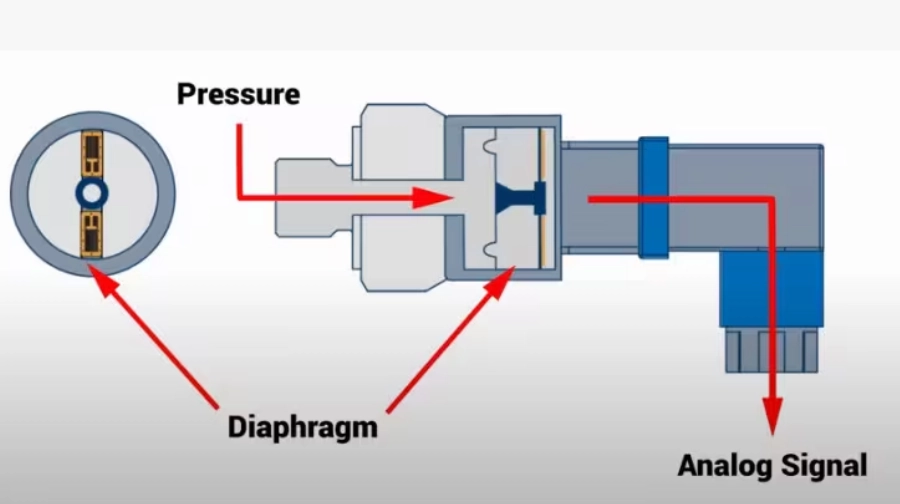
Now you know that a pressure transducer converts the physical force of a gas or liquid into a clean electrical signal. Read the following steps to understand how does pressure transducer work:
1. Detecting Pressure Changes
When a liquid or gas applies pressure to a sensor, its internal sensing element responds to the force. This is the first step in the pressure transducer function.
- Diaphragms: A thin metal or silicon diaphragm bends slightly when pressure is applied to it. This movement helps the sensor detect pressure changes.
- Strain Gauges: Small wires attached to the sensing element stretch or compress with it. This changes their electrical resistance.
- Piezoelectric Crystals: These crystals produce an electrical charge when pressure is applied. The charge changes according to the force acting on them.
2. Converting Pressure into Electric Charge
The sensing element turns the physical change into an electrical signal. The signal varies with the applied pressure and helps measure its level.
- Change in Resistance: When strain gauges stretch or compress, their resistance changes. The circuit uses this change to produce a measurable voltage.
- Electrical Charge: Piezoelectric crystals produce an electrical charge under pressure. The amount of charge depends on the force applied to them.
3. Generating an Electrical Output
After detecting pressure, the transducer produces an electrical output. This output can be:
- Voltage Output: The output voltage changes with pressure and can be read by compatible monitoring and measurement devices.
- Current Output: Some transducers produce a current signal, commonly 4–20 mA, for reliable transmission in industrial systems.
- Frequency Output: Certain transducers use changes in signal frequency to represent pressure changes in special measurement systems.
4. Improving the Electrical Signal
The initial signal may be weak or affected by electrical noise. So, a pressure transducer circuit processes this signal to make it suitable for connected devices.
- Signal Amplification: To ensure the measuring devices read pressure accurately, a signal amplifier helps. It increases the strength of a weak signal.
- Signal Conditioning: Filters remove unwanted electrical noise from the signal. The circuit also adjusts the output to match the requirements of connected equipment.
5. Sending the Final Output
After processing, the transducer sends the clean electrical signal to a connected device. Different machines use different types of signals depending on what the system needs to see.
- Voltage and Current Output: Most sensors send a steady analog voltage or current that increases and decreases with the pressure. Many industrial models use a 4–20 mA output.
- Digital Display: Digital gauges and pressure meters read the signal and show pressure values. Then, operators can easily check these readings during equipment operation. For the best-quality digital gauges in Saudi Arabia, you can connect with National Oil Groups.
- System Control: Smart control systems read the pressure signals to operate pumps, valves, and alarms. This helps maintain pressure within the required range.
What Are the Main Types of Pressure Transducers?
After learning about pressure transducer function, let us now learn about the three main types of pressure transducers:
1. Gauge Pressure Transducers
These measure pressure by comparing it directly to the normal air or ambient atmospheric pressure around us.
- Common Examples: Tyre pressure monitoring, HVAC systems, industrial hydraulics, and pipeline leak detection.
2. Absolute Pressure Transducers
These transducers measure pressure relative to a total/perfect vacuum (such as barometric pressure sensors).
- Common Examples: Barometers, altimeters (altitude tracking), and vacuum packaging machines.
3. Differential Pressure Transducers
These measure the difference in pressure between two separate points or ports.
- Common Examples: Filter monitoring, flow measurement across an orifice plate, and cleanroom pressure control.



How Does a Pressure Transducer Circuit Work?
A pressure transducer circuit processes the electrical changes produced by the sensor and converts them into a readable output.
1. Basic circuit arrangement
A basic pressure transducer circuit includes a power supply, sensing elements, resistors, and electrical connections. These components work together to detect pressure-related changes and produce an output. The exact arrangement depends on the transducer design. A pressure transducer connects tiny sensing elements to a flexible diaphragm inside the sensor. When gas or liquid pushes against the diaphragm, it bends slightly. The bending stretches or squeezes the gauges, changing their electrical resistance.
2. Role of the Wheatstone Bridge
The Wheatstone Bridge is a circuit made of four resistors arranged in a diamond shape. In strain-gauge transducers, these resistors help detect small changes in resistance. When there is no pressure, the bridge stays balanced and outputs zero voltage. When pressure is applied to the diaphragm, the strain gauge changes resistance. The balance breaks, and this produces a voltage.
3. Signal amplification
The voltage or electrical signal coming from the Wheatstone Bridge is usually very weak for a standard computer or screen to read clearly. So, an amplifier is used to increase this voltage and ensure the measuring devices can read it properly. The pressure transducer circuit may also use filters to reduce electrical noise and improve signal stability.
4. Power Supply and Output Connections
The pressure transducer circuit needs a stable power supply to operate its sensing and processing components. Output connections carry the processed signal to a display, controller, or monitoring system. Their arrangement depends on the transducer’s output type.
How Does Pressure-to-Current Conversion Work?
A pressure to current transducer converts measured pressure into an electrical current signal. Industrial systems commonly use the 4–20 mA output.
1. Converting Pressure into an Electrical Signal
The sensing element detects applied pressure and produces an electrical signal. The transmitter processes this signal and prepares it for conversion into a current output.
- Pressure Measurement: The sensor measures the applied pressure and produces a corresponding electrical signal.
- Signal Processing: Internal circuits adjust the signal before sending it to the current conversion stage.
2. Understanding the 4–20 mA Output
- 4 mA – Minimum Pressure: This represents zero pressure or the lowest point of the calibrated measurement range.
- 20 mA – Maximum Pressure: This represents the highest pressure value within the selected measurement range.
- Live Zero: The 4 mA starting point helps identify a broken wire or power failure. A 0 mA reading can indicate a signal problem.
3. How the Current Conversion Takes Place
A voltage-to-current circuit changes the processed voltage into a current signal. The current increases or decreases with pressure, staying within the 4–20 mA range.
- Current Adjustment: The circuit adjusts the output current according to changes in measured pressure.
- Signal Transmission: The current travels through connected cables to a PLC or monitoring device.
- Pressure Reading: The receiving device reads the current and converts it into a pressure value.
4. Why Is 4–20 mA Used in Industrial Systems?
- Current signals work well for long-distance transmission
- The 4 mA live-zero value helps systems identify wiring faults and power interruptions.
- Many industrial controllers, monitoring devices, and digital gauges support 4–20 mA inputs.
Businesses can check compatible options with trusted pressure transducers and HDI gauges suppliers in Saudi Arabia.
Common Applications of Pressure Transducers
Now that we have learned how does pressure transducer work, let us look at their main applications:
| Industry / Sector | Specific Application | What is Monitored / Controlled |
| Automotive & Transport | Tire pressure, brake systems, engine intake, and fuel lines | Fluid/air pressure for safety and performance |
| Medical & Healthcare | Blood pressure monitors, ventilators, and gas analyzers | Physiological pressure and medical gas flow |
| HVAC & Building Automation | Air ducts, refrigerant lines, and room pressurization | Air flow, pressure drops, and climate control efficiency |
| Oil, Gas & Petrochemical | Refineries, long-distance pipelines, and storage tanks | High-pressure medium levels to stop leaks and hazards |
| Aerospace & Motorsport | Cabin pressure, fuel systems, and brake/speed shifters | Extreme high-speed or high-altitude pressure changes |
Get High-Grade Pressure Transducers in Saudi Arabia
Whether you are monitoring pipelines or storage tanks, knowing how does a pressure transducer work, its types, and other details will help you choose the right sensor for your project.
With this smart device, your team can easily spot pressure drops or spikes before they turn into major problems. Upgrade your pressure monitoring systems with National Oil Groups. Trust us to get top-quality transducers for your project.
Check out our full catalog to find high-grade pressure transducers Saudi Arabia solutions. Our experts will help you select the right sensor for your circuit and conversion needs. Contact National Oil Groups to get a custom quote or speak with our technical support team.
Also Read – Top 7 Benefits of Full-Threaded API 20E BSL-2 Stud Bolts
Frequently Asked Questions (FAQs)
1. What is the main function of a pressure transducer?
The main pressure transducer function is to convert physical pressure from gases or liquids into a proportional electrical signal, so systems can easily measure, monitor, and control it.
2. What are the main components of a pressure transducer?
Main components include a sensing element (like a flexible diaphragm), a transduction element (like strain gauges), a signal-conditioning circuit, and a protective housing.
3. Why is a 4-20 mA output used in pressure transducers?
A 4-20 mA signal supports transmission over long cables. Its 4 mA starting point lets you easily detect broken wires or power failures.
4. Where are pressure transducers commonly used?
These are used in HVAC systems, oil and gas pipelines, refineries, automotive devices, and healthcare equipment.
5. How can I choose the right pressure transducer for an industrial application?
You must match the pressure range, check fluid compatibility, confirm the environmental protection rating, consider the measurement and output type, and match it with the operating conditions.